

How a 48/96 schedule works
A 48/96 schedule is two 24-hour shifts in a row, then four days off. That is 48 hours on and 96 hours off, which gives the pattern its name. The whole cycle is 6 days long, and it repeats without a break.
Fire departments use it most, and some EMS services do too. You can see your own dates in the 48/96 schedule calendar: enter the first day of a 48 you worked and every shift after it follows.
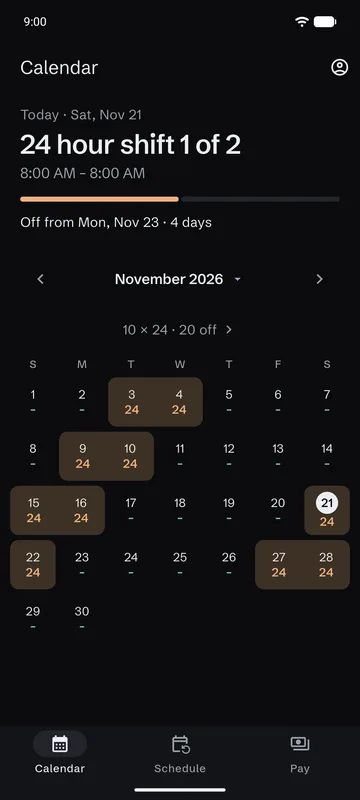
The 6-day cycle
Here is one cycle, day by day:
- A 24-hour shift, usually starting in the morning.
- A second 24-hour shift straight after the first.
- Day off.
- Day off.
- Day off.
- Day off.
Then the next 48 starts. You work 2 days in every 6, one day in three. Over a year that comes to about 2,920 hours on the clock, or about 56 hours a week on average, before leave and overtime.
How three platoons cover every day
A department running 48/96 splits its firefighters into three platoons, often called A, B and C shift. Each platoon works the same 6-day cycle, two days after the one before it:
- A works days 1 and 2.
- B works days 3 and 4.
- C works days 5 and 6.
So one platoon is on duty every day, and each platoon hands over to the next at the end of its 48. Your platoon letter tells you where in the cycle you sit; the dates follow from it.
How your days off move through the week
A 6-day cycle does not fit into a 7-day week, so your shifts move. Each new 48 starts one weekday earlier than the last: if one starts on a Monday, the next starts on a Sunday, then a Saturday, and so on. Over six weeks your 48 lands on every day of the week once.
That means your weekends off come and go. Some weeks you are off from Friday to Monday; a few weeks later you work the whole weekend. A calendar that follows the 6-day cycle, rather than a weekly one, makes it easier to plan around.
48/96 compared with 24/48
A 24/48 schedule is one 24-hour shift, then two days off, on a 3-day cycle. It puts you on duty one day in three, exactly like 48/96, so the yearly hours are the same. What changes is how the time is grouped:
| 48/96 | 24/48 | |
|---|---|---|
| Shifts in a row | 2 | 1 |
| Days off in a row | 4 | 2 |
| Cycle length | 6 days | 3 days |
| Trips to the station per 6 days | 1 | 2 |
48/96 gives you a longer stretch at home and half the trips to the station. 24/48 keeps every shift next to a day off, so you are at most one shift away from rest. Many departments also run a Kelly schedule, which takes a 24/48 and swaps one shift every few weeks for extra time off. The Kelly schedule guide explains how that works.
Daylight saving and a 48
A 24-hour shift that crosses a clock change runs 23 or 25 hours of real time. On a 48/96, one of your two shifts may cross it. The US daylight saving page and the UK page give the dates and what to check with your employer.
Seeing your own 48/96
The 48/96 calendar shows your month and a year at a glance, counts your days off, and can add every shift to your phone's calendar. If the dates look a day out compared with your department's chart, use the Earlier or Later buttons to move them by one.